

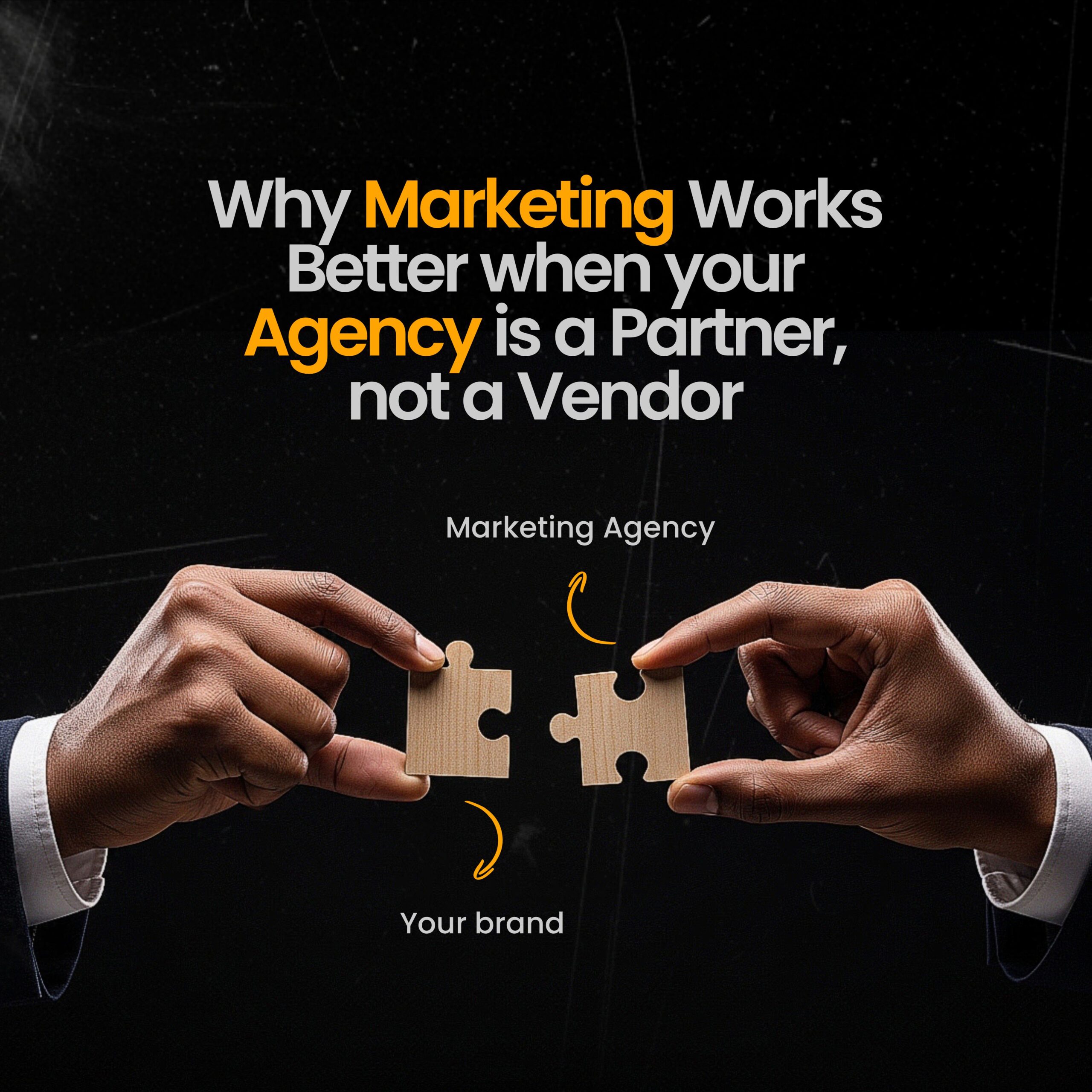
Many business owners have worked with agencies, invested in campaigns, reviewed reports, and still felt disappointed by the outcome. The work was delivered, timelines were met, and activity was visible, yet the results did not reflect the effort or the spend. Over time, this experience leads many brands to a quiet but firm conclusion: agencies simply do not work.
In reality, agencies do work. What often fails is not the capability of the agency, but the structure of the relationship. When an agency is treated strictly as a vendor, the focus shifts to tasks, deliverables, and timelines rather than business understanding and strategic thinking. This limits the agency’s ability to contribute meaningfully, even when the execution itself is solid.
Marketing performs best when an agency is treated as a partner, not a vendor. The difference is not just in terminology; it directly influences decision-making quality, efficiency, alignment, and long-term growth. In this article, we will explain why a partnership approach leads to better marketing outcomes, how it reduces waste and misalignment, and why the way you work with your agency matters just as much as the strategy you choose.
- Partners Understand the Business. Vendors Only Execute Instructions
The difference between a vendor and a partner starts with how much of the business they are allowed to see. A vendor relationship is transactional by nature: a task is assigned, a deadline is set, and delivery is expected. In this setup, the agency’s responsibility ends with executing what is written in the brief. Whether the brief is complete, flawed, or based on assumptions is not their concern. Their job is simply to deliver what was requested.
A partnership relationship, however, is strategic. Instead of focusing only on tasks, the agency is brought into the business problem itself. They are given context: how the company makes money, who truly influences buying decisions, what success actually looks like, and what internal limitations exist. This understanding changes how the agency thinks. Creative choices, media placements, messaging, and timing are no longer made in isolation; they are shaped by real business realities.
When an agency understands how revenue is generated, they can prioritise efforts that support growth rather than surface-level activity. When they know who the real buyers and decision-makers are, they avoid wasting resources on audiences that look good on reports but do not convert. When success is defined beyond impressions, clicks, or likes, marketing decisions are judged by impact, not just visibility. And when internal constraints are understood, recommendations become realistic and executable, not idealistic and disconnected from the organisation.
When an agency is treated strictly as a vendor, all of this insight is missing. The agency executes instructions without the freedom to question whether the instruction itself is the problem. As a result, marketing may be delivered on time and within budget, yet still fail to move the business forward.
Marketing rarely fails because execution was poor. It fails because the wrong problem was solved very efficiently. Partnership allows an agency to challenge assumptions, reframe the brief when necessary, and focus on solving the right problem, not just completing the task.
- Better Understanding Leads to Better Decisions
Marketing is not a single action; it is a continuous series of decisions. Every campaign requires choices about what message should lead, which audience should be prioritised, where the brand should show up, how often it should appear, and when it is wiser to pause or change direction. The quality of these decisions determines the outcome of the marketing, not just the quality of execution.
When an agency truly understands a business, it develops sound judgment over time. That judgment allows the agency to recognise what fits the brand and what does not, what the audience is already tired of seeing, and which approaches are likely to strengthen trust rather than erode it. These insights cannot be captured fully in a brief or discovered in a single campaign. They are built through consistent exposure to the brand, its market, and its performance history.
An agency operating only at an execution level lacks this depth. Decisions are made based on general best practices or surface-level data, rather than on a nuanced understanding of the brand and its audience. While the work may look polished, it often misses the mark because it is not grounded in informed judgment.
Partnership creates space for better thinking. Better thinking leads to better decisions. And better decisions, repeated consistently, are what produce meaningful marketing results.
- Long-Term Partnerships Reduce Waste and Improve Efficiency
Every new agency relationship comes with a learning curve. Time is spent understanding the brand, testing assumptions, identifying what works, and correcting early mistakes. This process is necessary, but it is also costly. When brands change agencies frequently, they pay this cost repeatedly, without ever benefiting from long-term learning.
A long-term agency partner builds on accumulated knowledge. Past campaigns inform future strategies, mistakes are not repeated, and successful approaches are refined rather than abandoned. Over time, the agency becomes more efficient, not because less work is done, but because decisions are made faster and with greater accuracy.
This continuity reduces wasted spend, prevents conflicting brand messages, and creates a clearer marketing direction. Instead of restarting the learning process with each new engagement, the brand benefits from compounded insight. Marketing becomes less about trial and error and more about deliberate progress.
Efficiency in marketing is not achieved by doing less. It is achieved by retaining knowledge and applying it consistently over time.
- Partners Think Long-Term. Vendors Think Short-Term
Vendors are typically focused on delivery: completing campaigns, meeting deadlines, and closing out projects. Their success is measured by output. Partners, on the other hand, are invested in long-term outcomes. Their success is tied to the growth, credibility, and sustainability of the brand.
When an agency operates as a partner, it considers the long-term implications of every recommendation. This includes protecting brand reputation, avoiding short-term tactics that may damage trust, and prioritising strategies that build lasting equity even if they take longer to show results. Partners are also more willing to challenge ideas that may look appealing in the short term but are misaligned with the brand’s long-term goals.
Short-term results can create activity, but they rarely build durable brands. Long-term thinking ensures that marketing efforts compound over time instead of being reset with every new campaign. Marketing works better when someone is looking beyond the next deliverable and focusing on sustained growth.
- Partnership Creates Alignment, Not Conflict
Many challenges in client–agency relationships are not caused by poor performance but by misalignment. When goals, expectations, and definitions of success are unclear, even good results can feel disappointing. Without alignment, communication becomes strained and trust erodes.
A partnership model encourages openness and shared ownership. Goals are discussed clearly, progress is reviewed honestly, and adjustments are made collaboratively. This reduces friction and creates an environment where feedback is constructive rather than confrontational.
When both sides are aligned on objectives and expectations, collaboration improves naturally. Decisions are easier to make, accountability is clearer, and performance improves. Alignment is not a soft benefit; it is a critical factor in effective marketing.
Where NUGES Comes In
At NUGES, we do not see marketing as a list of tasks to be completed or campaigns to be ticked off. We see it as a long-term business function that should support growth, protect brand value, and improve decision-making over time. This perspective shapes how we work and the kinds of relationships we build with our clients.
We work best when we are embedded as partners, not positioned on the outside waiting for instructions. Partnership allows us to understand how the business truly operates, question assumptions that may be limiting performance, and contribute thinking that goes beyond execution. It gives us the clarity needed to recommend what will actually move the business forward, not just what looks good on a report.
Our role is not limited to running campaigns. It is to improve marketing judgment by helping brands make clearer, more informed decisions. It is to build consistency, so that every message, channel, and campaign reinforces the same strategic direction instead of competing with it. It is to reduce waste by eliminating repeated mistakes, misaligned efforts, and unnecessary spend. And it is to support sustainable growth by focusing on strategies that compound over time rather than chasing short-term wins.
We believe that strategy without alignment will always fail, and execution without understanding will always underperform. When marketing is approached as a partnership, thinking improves, collaboration strengthens, and results become more predictable.
Marketing works better when your agency is a partner. And when the relationship is right, the results follow.